Cars dominate daily life. Cities are built around them, daily routines are planned with them in mind, and the economy depends on them. Reliable transportation is a necessity for most people, as seen in how they commute. While just 6% of U.S. residents walk or use public transportation to get to work, over two-thirds rely on their cars.
But there are cities where many more people walk as their primary mode, often accompanied by taking public transit. What’s the biggest difference? Walkability.
Pedestrian-focused cities have been shown to benefit public health, boost economic mobility, and benefit the environment. Prioritizing this type of infrastructure is especially important for those without access to a vehicle; for some, walking or taking public transit are the only ways to get around. 8.3 percent of Americans don’t have access to a vehicle, and more than a third would consider ditching car ownership due to high costs.
In this Rent. article, we’ll explore the ten most walkable cities in the U.S. for renters, looking at their infrastructure, amenities, and everything else renters need to know. So, whether you’re a current resident or are looking for a new place to live, tie up your laces as we discover the most walkable cities in the United States.
List only includes cities with a population of 200,000 or more.

1. San Francisco, CA
- Walk Score: 89
- Average Rent Price (1-bedroom): $3,587
- Most Walkable Neighborhoods: Tenderloin, Chinatown, Polk Gulch
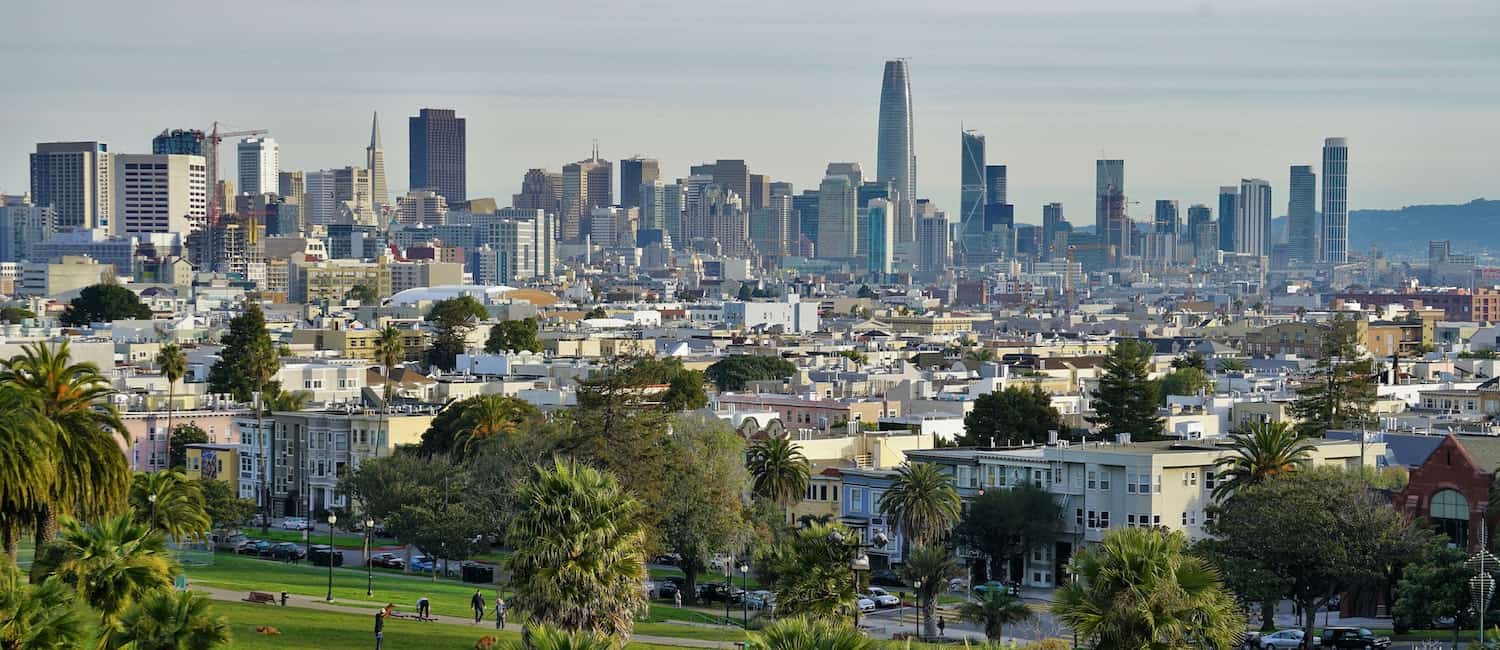
The steep and scenic hills of San Francisco don’t slow residents down – San Francisco is a walker’s paradise. The compact, historic city is home to iconic parks, cobbled streets, and landmarks everywhere you turn that make it hard not to explore. Plus, it has consistently prioritized improving pedestrian access and safety. Great cuisine and plenty of job opportunities doesn’t hurt, either.
As a result, San Francisco has a remarkably low percentage of residents who commute to work by car (29.7%), largely because they can easily walk or use public transit. 10.3% walk to work, and another 22% use public transportation. The city’s famous cable cars, Muni trains, and ride-share programs are all popular ways to get around.
Renters in San Francisco can enjoy a built-in workout simply by exploring the city’s hilly streets. In fact, 100% of residents live within a 10-minute walk to a park. Golden Gate Park and Crissy Field are some of the best in the city. With its famous hills and walkable neighborhoods, it’s no surprise that San Francisco also ranks as the seventh-fittest city in the country.
San Francisco houses for rent | San Francisco apartments for rent | San Francisco homes for sale

2. New York, NY
- Walk Score: 88
- Average Rent Price (1-bedroom): $5,150
- Most Walkable Neighborhoods: Bowery, NoLita, Little Italy
New York City is the second-most walkable city in the U.S. Its massive layout is split up by five boroughs, each with a distinct personality. Manhattan is the most walkable borough, with the Bronx close behind.
On the whole, NYC offers an incredibly simple numbered grid system that makes it easy to get to where you need to go, including nearly 30,000 acres of walkable parks and dozens of museums. And with neighborhood after neighborhood of social centers and commercial hubs, there are hardly any empty stretches to trudge through.
An essential part of living in New York is walking to and from the subway. The MTA, New York’s transit system, is by far the largest in the nation, with nearly 20x the annual ridership of any other metro and 3x the number of stations. This makes it easy to get pretty much anywhere without a car. As such, just one-fifth of the population drives to work every day, and over half take public transit or walk. This car-free lifestyle translates to real economic savings for residents – a staggering $19 billion in 2010.
New York City houses for rent | New York City apartments for rent | New York City homes for sale

3. Boston, MA
- Walk Score: 83
- Average Rent Price (1-bedroom): $4,087
- Most Walkable Neighborhoods: Chinatown, North End, Beacon Hill
Home to renowned universities, art institutions, architecture, and personality, Boston is a remarkably walkable city.
Like New York, Boston was founded centuries before cars were invented, so it retains its human scale and beautiful, historic neighborhoods. Pair this with a high-quality public transportation system, and you can see why Boston has the highest percentage (13.9%) of commuters who walk to work out of the cities on this list. Locals don’t need a car to accomplish most of their day-to-day tasks.
Renters can look forward to a beautiful city on the harbor, full of colorful landmarks, iconic cuisine, and endless attractions. Take a bite of clam chowder, stop in at a Dunkin’, go ice skating at Boston Common, or spend a day exploring the city’s revolutionary history.
If you’re a renter on a budget, finding an affordable unit may be difficult, since the city is popular and quite compact. If possible, avoid moving on September 1st (locally known as Allston Christmas) – the city’s largest moving day of the year.
Boston houses for rent | Boston apartments for rent | Boston homes for sale

4. Chicago, IL
- Walk Score: 77
- Average Rent Price (1-bedroom): $2,228
- Most Walkable Neighborhoods: East Ukrainian Village, Near North Side, Wicker Park
Characterized by its bold skyscrapers, lakeside parks, and midwestern weather, walking is easy in the Windy City. And when it’s too cold or wet to walk in the winter, the Pedway provides five miles of tunnels and bridges that connect downtown.
If you’re a new renter considering living in Chicago, you have a lot to look forward to. Chicago has a wonderfully varied and walkable downtown, made up of several neighborhoods. The Loop contains busy gridded streets below towering skyscrapers, along with world-famous parks like Grant and Millennium, and attractions like Buckingham Fountain and The Bean. This extends out to the blocks of high-end retail on Michigan Avenue, known as the Magnificent Mile.
19.5% of residents commute by public transit, one of the highest in the nation, but nearly half (45.5%) drive to work. The “L” trains are a popular way to get around without a car. People still tend to walk and use public transportation less frequently in the bitter winter, though.
Chicago houses for rent | Chicago apartments for rent | Chicago homes for sale

5. Washington, DC
- Walk Score: 77
- Average Rent Price (1-bedroom): $2,514
- Most Walkable Neighborhoods: U-Street, Dupont Circle, Mount Vernon Square
With grand parks, promenades of national landmarks, and condensed neighborhoods, Washington, D.C. is all about walkability. Its most prominent greenway is the National Mall. The 2.5-mile memorial park offers easy walkable access from the Potomac to Capitol Hill. And it’s a few simple blocks to the waterfront and Navy Yard, George Washington University, Downtown, Penn Quarter, and Mt. Vernon Square.
Getting around without a car in DC is so easy that over one third of residents walk or take public transportation to get to work – behind only New York and Boston. And roughly 200,000 people live within a half-mile of a Metro station. Those that are further away from the train often live along their own walkable main streets, in areas like U Street, Georgetown, Union Market and Adams Morgan.
Because DC is the nation’s capital, it’s not unusual to see tourists, lawmakers, lobbyists, students, and diplomats alike walking between appointments, museums, and business lunches. Washingtonians tend to get work done while walking between destinations.
Washington, DC houses for rent | Washington, DC apartments for rent | Washington, DC homes for sale

6. Miami, FL
- Walk Score: 77
- Average Rent Price (1-bedroom): $2,793
- Most Walkable Neighborhoods: Downtown, Wynwood, Little Havana
A sun-soaked city dredged from forested marshland, Miami is famous for its high-rise resorts, dance clubs, and Art Deco buildings. The people make Miami what it is, though – a diverse, authentic city rich with culture, cuisine, and experiences. And it’s surprisingly walkable, given how car-dependent many areas are.
Miami’s walkability shines through its downtown, historic neighborhoods, and famous beaches. South Beach and Surfside offer scenic shoreline walks, while Little Havana and Coconut Grove are lively, pedestrian-friendly havens. Public transit options like the Metrorail, Metrobus, and Metromover make it easy to get around the core parts of the city, though with lower ridership than most other cities on the list.
Renters can enjoy city life, suburban quiet, or a laid-back beach vibe, all within city limits. Plus, you’re usually close to beaches, the Everglades, restaurants, and entertainment, so there’s always something to do.
Miami houses for rent | Miami apartments for rent | Miami homes for sale

7. Oakland, CA
- Walk Score: 75
- Average Rent Price (1-bedroom): $2,569
- Most Walkable Neighborhoods: Downtown, Koreatown-Northgate, Fruitvale Station
Oakland is the seventh-most walkable city in the country. As the transportation hub for the region, there are plenty of options for getting where you need to go. It’s easy to walk to a nearby BART or AC Transit station for a longer trip, or simply stroll along the colorful city streets.
As San Francisco increases development and rents remain among the highest in the nation, you can make the case that Oakland is the more desirable Bay Area city. Oakland is more affordable, has a booming arts and restaurant scene, and has fewer hills to climb, combined with a number of secret staircase walks. The difference is in the local inclination to refer to San Francisco as the City and Oakland as the Town.
Walking around Oakland has less bustle than across the Bay – plus, it’s generally warmer and less foggy than San Francisco. The East Bay city still has intimate and compact neighborhoods, like Temescal and Adam’s Point, which are perfect for walking. And there are many lovely public green spaces, too, including the Oakland Zoo and along Lake Merritt.
Oakland houses for rent | Oakland apartments for rent | Oakland homes for sale

8. Philadelphia, PA
- Walk Score: 75
- Average Rent Price (1-bedroom): $1,827
- Most Walkable Neighborhoods: Center City West, Rittenhouse Square, Washington Square West
Philadelphia is often called a city of neighborhoods, and for good reason. It’s a historic city built for foot traffic, not for cars, so it’s no surprise that the City of Brotherly Love is very walkable. Rittenhouse Square, Fishtown, and East Passyunk are home to some of the busiest and most well-known cultural and historical attractions, like museums, gardens, theaters, and more.
Around 10% of residents walk to work, with another 17% using public transportation. This is much lower than Northeastern cities like Boston and New York, but still relatively high. SEPTA provides train, subway, trolley, and bus lines for a nearly 2,200-square-mile region.
It’s easiest to get around without a car downtown, but nearly every neighborhood in Philadelphia is walkable in itself. Its paths and sidewalks are easy to navigate, from cobblestone streets to its 10,000 acres of public land. Walking is even more fun when you can stop for a famous cheesesteak or soft pretzel most blocks.
Philadelphia houses for rent | Philadelphia apartments for rent | Philadelphia homes for sale

9. Seattle, WA
- Walk Score: 74
- Average Rent Price (1-bedroom): $2,339
- Most Walkable Neighborhoods: Downtown, International District, Belltown
The largest city in the Pacific Northwest is quite walkable, and it’s been getting better. Seattle has undergone tremendous tech-fueled growth in the past decade, helping bring density and amenities to the region, which has greatly improved walkability. More than 22% of residents now either walk or take public transportation to work.
The city’s landscape is a unique factor to consider, though. Walkability is best in the compact and flat Downtown and Capitol Hill, spreading out into South Lake Union and the International District. Many landmarks are fairly spread out, though, so be prepared to have your walking shoes on. Steep hills and narrow streets are common throughout the rest of town.
King County Metro and Sound Transit run the Link, Sounder, and many BRT routes to reduce reliance on cars, but the system isn’t as robust as most other cities on this list. Even so, 14.2% of residents use public transportation to commute to work. Seattle has the third-worst traffic in the nation, which is a reason why the government is investing so heavily in alternative transportation. This all has the effect of building a more pedestrian-focused city, improving walkability, and reducing reliance on cars.
Seattle houses for rent | Seattle apartments for rent | Seattle homes for sale

10. Long Beach, CA
- Walk Score: 73
- Average Rent Price (1-bedroom): $2,339
- Most Walkable Neighborhoods: Franklin, St. Mary, Downtown
Spend a day at the ocean in Long Beach, the tenth-most walkable city in the U.S. Despite Southern California’s reputation as car-centered urban sprawl, Long Beach defies stereotypes with its great walkability. With a gorgeous 5.5 miles of beaches along the coastline, who wouldn’t want to walk, bike, or even inline skate? Other trails lead to landmarks like the Queen Mary and Pier J.
Both sides of town offer walkable public waterways. The Los Angeles River forms Long Beach’s western border, with the western terminus of the famous Los Angeles River Bikeway. The eastern end offers a bevy of parks along the marina at Belmont Park and Naples.
Despite being a shipping hub, renters in Long Beach can enjoy a relaxed vibe and year-round beachfront views. Stroll along boardwalks, discover new restaurants, or venture inland to see the suburban side of the city. Ocean Boulevard and Shoreline Village are especially walkable spots along the shoreline.
An overwhelming majority (70%) of residents drive to get around the city, unfortunately, with just 6.2% walking or taking the region’s small public transit system.
Long Beach houses for rent | Long Beach apartments for rent | Long Beach homes for sale
Methodology
Data gathered from Walk Score. Walk Score rates areas from least to most walkable on a scale from 0-100. To calculate a Walk Score for a city, Walk Score analyzes and aggregates thousands of walking routes to nearby amenities, population density, and metrics such as block length and intersection density. Points are awarded based on the distance to amenities in each category.
Commuting data comes from the U.S. Census Bureau American Community Survey. Rental data comes from Rent.com.
All data sourced September 2024.